Writing
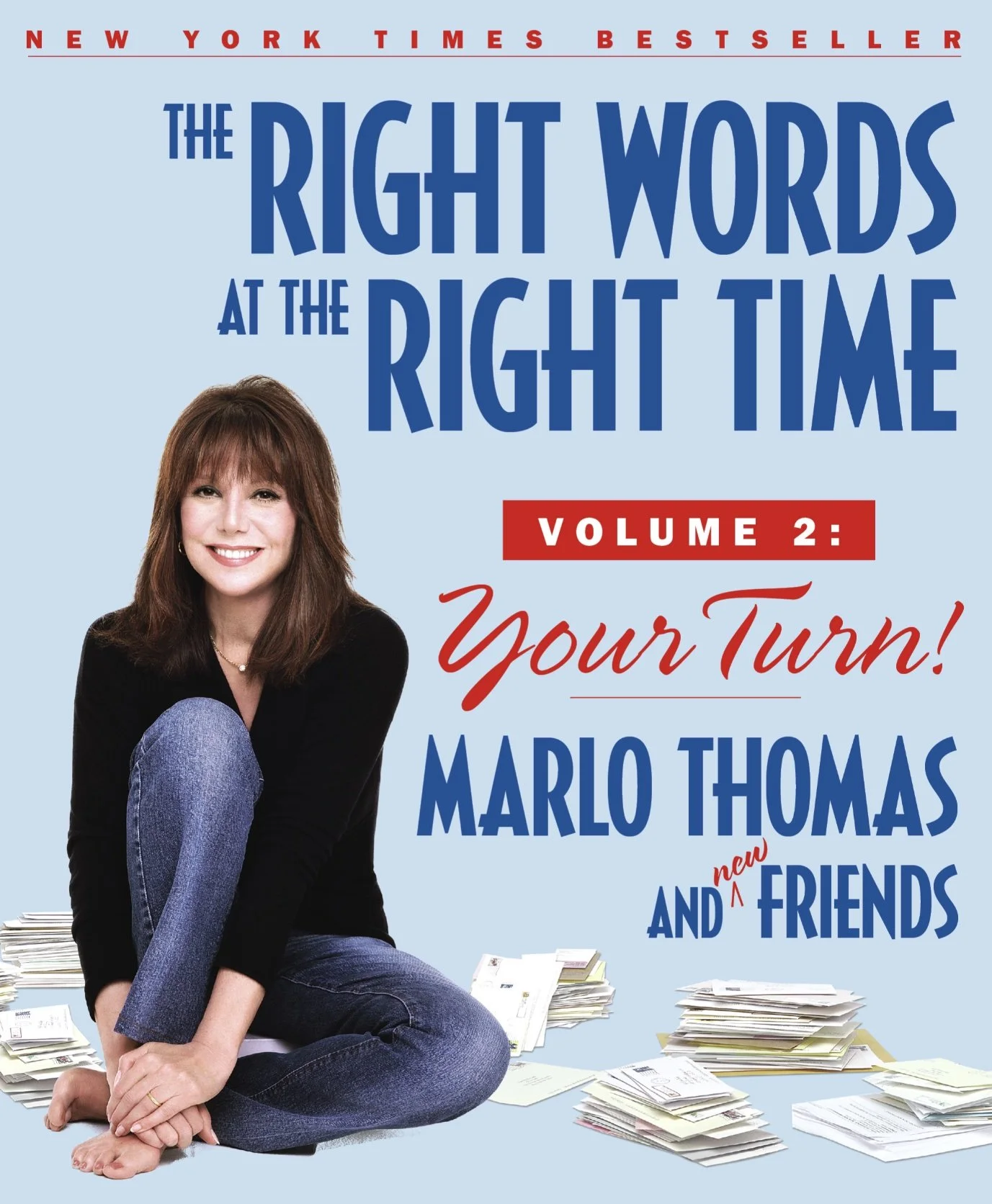
Very much like making music, writing is a “calling,” something that one feels born to do - an essential act of being. As a full time business professional and as a pianist, I had written a few smaller pieces including one selected and published by Marlo Thomas for her book, “The Right Words at the Right Time.” I had also written some heartfelt pieces about my love of dogs and submitted them to the New York Times for columns like “Modern Love.” Once, I even got a reply from them saying that my piece was very moving, but because it emphasized “dog love,” it wasn’t quite right for their column.
At the same time, I had sharpened my skills by writing or editing more than 1400 articles for the Bedtime Network website since I’m quite sure that I always believed that sometime, somewhere, the moment would come when I would begin to tell my own stories.
That moment finally came to pass during the pandemic. Beginning with my memoir, “Confessions of a Hidden Pianist.” Quickly I found that the words began to roll out of me and when I was finished with that, I was compelled to write my first novel.
Both of these new works are in the process of finding their way forward. I’m excited about seeing them on the printed page or the silver screen - however the future decides they should emerge. Most of all, I’m thrilled about the possibilities of sharing them with you.
Published Works
Mercurio has written two books. Her first, “Confessions of a Hidden Pianist,” is a personal memoir which takes on the universal theme of never giving up on your dreams. She recently completed her first novel which she hopes to share with the world in the near future.
Lisa Mercurio
“You Just Know”
-
MY LIFE IN DOG YEARS
By Lisa Mercurio
How do you keep track of the times of your life? Elementary school days, college years, first job, salary increases or the cars you have driven. Perhaps as simple as “happy days,” or bellbottom years, I believe we are a lot like the trees; quietly tracking our time on the planet by creating an imaginary series of carbon trunk rings. My personal chronology is registered in “dog years.”
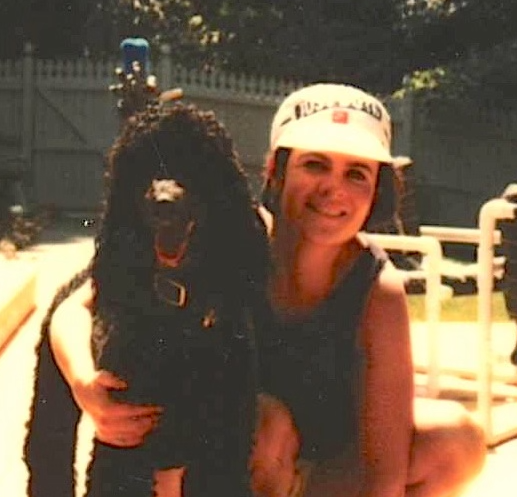
When I turned thirty years old (or two hundred ten in dog years), I wanted a dog. Fertility clock ticking, the desire was sudden and urgent. What’s more, it couldn’t be just any dog; it had to be a standard poodle. I found a classified ad in the paper while visiting my parents out on Long Island shortly after my birthday and before I knew it, I was picking up a puppy from a private home in King’s Park. She wore a slender pink ribbon around her neck, a kind of decoration that the breeder had used to dress up my birthday gift. With inky black eyes that were both intense and shy and a curly coat to match, somehow, I knew her name was, “Lola.”
Love at first sight doesn’t begin to describe the immediate bond I felt. My mother was with me the day I took her from her littermates, and in the car on the way back home, she remarked, “Funny, Lisa, but she looks just like you.” It was the right thing to say to someone that was eager to have a baby. Lola was my baby and what’s more, I crazily believed that this lovely girl and I did share some qualities of physical resemblance. She was my constant companion, introducing me to a world of other dog lovers in Brooklyn’s Prospect Park. Seven years later I left that beloved neighborhood and moved to Manhattan where my great girl would lie by my side throughout eight, lonely months of bed rest brought about by a high-risk pregnancy. Her jet-black curls were flecked with gray now, but so were mine and when the twins arrived, she became their immediate nanny, a self-appointed position. At that same moment, she seemed to evolve from the “baby,” role I had given her into my four-legged “wisdom-girl.”
Faithful and saint-like, Lola was the ultimate confidante. She had her, “people friends,” and she had her “dog friends,” but she also had her true loves and just like a true love would, she would tell me everything I needed to know without words (including who not to marry, who was dangerous and who could not be trusted). On occasion, she was eerily stoic, yet always void of aggression and unquestionably kind. She loved steak and bagels and pizza and hot dogs. I couldn’t believe my good fortune because in addition to all of these things, she also loved me. Her favorite game was, “chase,” and throughout my thirties and into my forties, I only wanted to live up to the quality of love she deserved. Above all, and perhaps selfishly, I was never prepared to lose her.
You see, I’m one of “those,” people, the kind that cannot live without a dog. Not a crazy person, but a crazy-for-dogs person. I think it’s important to know that about oneself. As a human, I simply don’t feel complete unless I have the companionship of a dog. A dog to love, a dog with whom to wrestle and roll around, a dog to tell my innermost secrets; I believe that there is nothing, absolutely nothing like a dog.
I don’t really remember a time in my childhood when I didn’t have a dog to love. My childhood memories are all punctuated by the disappearances and uncertain presence of our various family dogs. From “Fifi,” a toy poodle that ran off never to return leaving me broken-hearted, to a beagle rescue named, “Ginger,” that my mother “gave away,” when I was off at school one day, it wasn’t until a beloved collie we called, “Blue” appeared during my teen years that I finally had some canine stability in my life. When I left for college, I missed him terribly. Four long years in his life passed while I completed mydegree, but by the time I returned home, he was an old man. I was not there when he died, and when I learned that he was gone, I remember feeling as though my childhood went with him.
What soon followed were my only dark, “dog-less” years, seven human years, to be exact. I had finished college and was building my professional career. It was a time of soul-searching, late nights working and of marrying the wrong man. There was an inexplicable void in my life. The career was moving forward but I felt that my family life was untethered. To add insult to injury, it seemed that all my human contacts were breeding and rejoicing. Surrounded by friends and family that seemed to procreate as easily as Golden Retrievers only served to increase my frustration. Desperate to build a home life, I finally realized that it was time to have my own dog. She would be the first in my adult life but my world finally came together with the arrival of Lola.
And so nearly sixteen years later, when my devoted friend was near death and my insides were aching, my neighbor, a passionate dog and animal lover, showed up at my door with a small book called, “The Last Will and Testament of Silverdene Emblem O’Neill.” A powerful piece of prose written by the American playwright, Eugene O’Neill, it was intended as a consolation piece for Carlotta, his wife, who had become grief-stricken over the loss of their beloved dog, the Dalmatian known as “Blemie.”
“Dogs do not fear death as men do. We accept it as a part of life, not as something alien and terrible which destroys life.”
Through O’Neill’s tender personification and words, for the first time, I could see and understand that dogs, in their eminent wisdom, are completely comfortable with their own relatively short life span. It is only we as humans that grapple with the brevity of their years against the comparative longevity of our own. Able to learn all of life’s lessons in a fraction of the time, it would seem to me that a dog’s life is more sanctified. They understand the meaning of fidelity, true love, companionship and all that is held dear with much greater immediacy. Perhaps they understand, and rightfully so, that there is no time to waste.
I presented the O’Neill piece to my second husband, a well-known composer and conductor who though familiar with much of O’Neill’s work, did not know this small but very dear text. He found himself so inspired by the piece that it has since become a large, four movement symphonic work called, “A Grateful Tail.” Created to celebrate our love of dogs through music, he has done for me as well as everyone that has ever loved a dog, what O’Neill did for Carlotta.
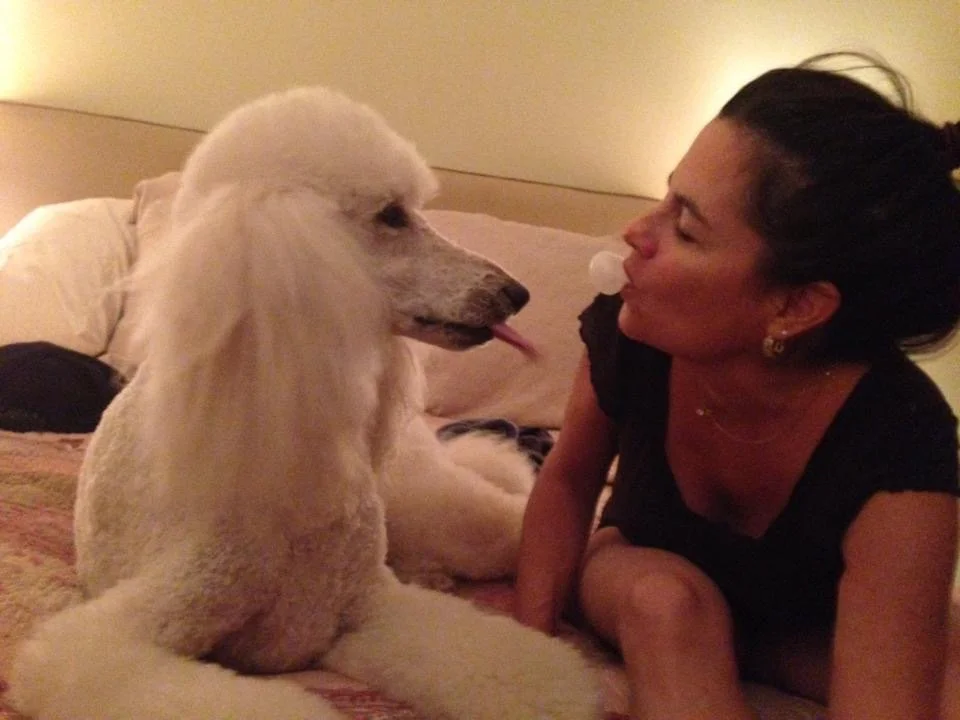
And because of O’Neill’s text, I also learned that it would be okay to go on to love another dog; that adding another to my adult life could never, ever eradicate the love I will always hold for Lola. That dog is not just any dog; she is, “Ava,” the love child I share with my husband. A creamy, white standard poodle, she is brilliant and high spirited and always “thinking,” of something to force us out of our daily routine. Born with the communication powers of a rock star, she makes everyone feel that she is singing right to them (or in dog terms: fetching just for them). It’s like having a, “forever four-year-old,” in the house. She is my husband’s Muse and my sidekick, endlessly entertaining and unfailingly sweet. Our Ava is also the family dog and one day soon, she will take on another role; to be there for my husband and I when the twins go off to college and we face our own empty nest.
I cannot think of the day that she will leave this earth. I prefer to live in the moment, much the same as a good dog would. And as for the dogs in my lifetime, who knows who will be responsible to lead me home in my old age. I know only that there will be one.
-
Description text goes hereShe flew overnight on an American Airlines redeye from Los Angeles into LaGuardia airport one October afternoon. Filled with nervous excitement, I was in a taxi on my way to meet her. I had lost my standard poodle “Lola” of nearly fifteen years just a few weeks earlier, a dog that I had had for the better part of my adult life, and it seemed that my heart would not stop aching until I knew that there would be another. My husband, with a combination of insight and practicality, had cautioned me not to plunge ahead so quickly. “Dear, I wouldn’t replace you this fast,” he quipped, but my quest to fill the void had hurled me forward.
Armed with firm instructions not to let her out of her traveling crate until I had opened the front door, the breeder had explained that this puppy would “know home,” when I released her. Oh, the agony of that very first cab ride! I remember the little yelps from the back seat and how I could hardly wait to hold her. Surely I will never forget how that bundle of cream-colored curls tumbled out into my kitchen and kissed me all over as if she had known me forever. It was a grateful beginning for both of us for I was immediately in love and she was liberated from her journey. Ava, “La Maestra,” had arrived.
It was clear to me from the start that things with Ava would be different. My husband reminds me of the stern lecture I gave her a few short weeks after her arrival. “Listen you -- you have some mighty big boots to fill,” an inevitable and somewhat unfair comparing of her to her predecessor. I don’t recall what Ava had done to warrant such a reaction from me then, so few were the naughty things she ever did as a puppy. She once chewed some stereo wires, a delicious temptation dangling from the wall during apartment renovations. And one night after we had returned home late from the theater, I remember the panic I had felt after she had scarfed down a knee stocking. Other than those few incidents, the classic, destructive puppy-isms seemed to bypass our “Ava-bear,” “Ava-boo,” or “Miss Ava.”
Feisty; verbal, barking at us to express an urgent need for attention or to divert us to play “chase,” she would gently wrap her puppy teeth around my hand and lead me to her bowl to tell me she was hungry. Standing on a chair, barking at the Roosevelt Island tram whenever it was stuck, she regularly monitored the action above and below our fifth floor apartment by standing on two legs and then resting her elbows on the windowsill. We referred to this stance as, Ava’s “Larry King” pose. Ready to interview, ready for action, our neighbors in catty-cornered apartments loved to watch her from afar.
A statuesque, show quality poodle that hailed from California-based champions, she was, nonetheless a New York girl through and through. She loved Central Park as much as I did, and seemed to know the location of every water fountain. As a popular subject of tourists, she patiently stood for photos engaging with admirers, enough so that I might have retired with the proceeds had I wanted. Ava attended dinner parties (often without us) and maintained a quasi rock star status at Bloomingdale’s whenever we happened to stroll on through. No one could miss her sexy sashay and she elicited whistles and smiles from everywhere. “Ava, like Ava Gardner,” we would say.
A study in contrasts, she was a physical presence as much as an emotional one; a tomboy yet a beauty queen. Strong of heart and mind, she was the self-appointed mayor of the dog park, galloping like a small pony, occasionally scolding pooches that behaved badly and stealing balls from those that were not clever or fast enough to keep up whenever the spirit moved her. Poodle personified.
Inside our home, we witnessed Ava, an intuitive creature that would sense our every mood. “A human stuck in a dog costume,” I would often declare. If there were tears, she would lick them away. A migraine? She jumped into bed with me for comfort. A hug between husband and wife could only mean an opportunity for Ava to spontaneously poke between our legs and be the third wheel, and if there was a chunk of watermelon or mango to be had, she was first in line. Hers was an insistent yet pure love; her sense of self and character always shining through, demanding to be considered yet gracefully in our midst.
But the real “Ava magic,” was made of an exceptional combination of companion, confidante and partner - a “love child,” that had uncommonly blurred the lines between species. She maintained intimate and unique relationships with each member of the family and many friends, but none more than my husband and me. She was a night owl sharing many a midnight snack of apples and cashews with him while he worked and studied, and yet she would be fresh as a daisy for me at dawn as I downed my morning coffee and we dashed off to the park together. Without question, she had successfully healed my broken heart; something I believed impossible when Lola passed into the great beyond.
We didn’t see her illness coming. Still rallying to play ball, perhaps panting a bit more than usual, appetite waning, she made every effort to please and we just chalked her sudden slowing down to the inevitable passing out of youth into middle age. Like many dogs, her innate stoicism enabled her to hide her discomfort from us until the very end. Perhaps for this reason along with many others, we were so very unprepared to say goodbye.
It was not until she was gone that I realized that I had taken all the love I had had for her predecessor and put it safely back into her. She returned it easily by a thousand; the circle of dog love shared between us forcing me to recognize that she had increased my own capacity to love simply just by being her.
In Memory of Ava “La Maestra” August 16, 2006 - January 11, 2016
-
His best friend’s name was Harvey. It’s such a long time ago now that I can only recall the most important things; how he made me feel and, how he made my dad feel.
He was so funny in a kind and geeky way. He looked funny too. Black eye glasses. Balding. To my then very young self, he was also in possession of a creative sense of humor. I mean, have you ever seen anyone wash their eyeballs? Well he did, or at least, I thought he did.
Yeah. It was a schtick; kind of like when an old uncle would find a quarter behind your ear. In this case, he would take off his black spectacles, close his eyes, attempt to screw them out of the sockets with closed fists, and then make believe he was popping them into his mouth. Side to side. Swirling around like two swollen gum balls, he pretended to wash them and then pop them back into the sockets. Presto change-o. Harvey had cleaned his eyeballs!
What kid wouldn’t be amazed?
I didn’t believe it, not really, but I do remember wanting to believe it. For if you could clean your eyes, you could see everything more perfectly, right? How marvelous and how ever hopeful.
My next memory is that we never saw him again. Dad’s friend Harvey died in the late 1960s. In my mind’s eye, he was here one day and gone the next.
Since then, my dad has never had a best friend, unless of course, you count my mom. Harvey was in his twenties. In those days, people spoke in hushed tones of illness. They didn’t speak openly of cancer, least of all around small children, and I remember learning of his illness many years later, not when I was a measly five or six year old but when I wondered aloud, “whatever happened to Daddy’s friend Harvey?” I believe I pressed my parents for answers. Not only didn’t they speak of cancer, but they certainly didn’t discuss a man with breast cancer.
“Unheard of,” you might say, though it most certainly is not.
My dad was sad. I distinctly remember seeing tears in his eyes both then and again over the years, whenever Harvey's name was mentioned. Eventually, I tried not to mention his friend’s name because that far away look would come back and his voice would take on an uncomfortably raspy sound, as if he needed to clear the lump in his throat. I didn’t want to do that to him; to make him remember something so raw, so difficult to process. The trauma of losing someone so dear is something I understood then, but I am learning to know this feeling even more now, because it’s happened to me too, and now, it’s happening again.
The news came in from “M," via text message. Shocking news, though I half expected it for some time. “It’s not good. They told me it’s weeks, or months, but that I shouldn’t think about years….I’m going to be near my brother’s house for hospice care.”
My friend M is a relatively new friend, someone I’ve only known in this decade, unlike Dad’s friend Harvey whom he had known since kindergarten. As an adult, one doesn’t make that many close friends. I find that many of my closest friends are those that I’ve held for a long time, but every once in awhile, a new one comes along; someone that you feel or believe you’ve known from perhaps another lifetime. So strong is the immediate connection with these newer friends that you just know you’re going to be buddies for a long time going forward.
And this was the way it was for me with M. We met for the first time by chance, at a snobby opera dinner, both of us as friends of a friend that has since ironically, tragically also passed. We discovered that our childhoods occurred in neighboring Long Island towns. He told me about how he had just traveled to Antarctica with his Dad; the trip of a lifetime that he ached to take knowing that the chances for such a journey with an eighty-nine year old man were both fleeting and limited. The conversation was off to the races and on that night at the opera gala dinner, we truly kept each other drunk on story-telling, marveling at the prevalence of wannabes in our midst: a room abuzz with divos and divas from a bygone era as well as those desperate to be recognized for the first time.
M is the kind of person with whom you would want to take long walks. Though we were anything but romantic friends, for he is gay and I am a happily married woman, we were quite intimate. I was immediately at ease just telling him things. I was driven to take my beloved standard poodle with me to accompany us on our first, long stroll in Central Park. It was there that I revealed that I had thought I would be the next Carole King. Words I couldn’t easily admit even to myself, I found myself blurting out to him. “How did I end up becoming a classical pianist rather than a pop star?” And then, “How was it that I got onto the business track and became a major record company executive rather than a pianist?”
He had been writing soap operas, and plays and books and even Broadway shows — a real, award-winning writer, though the soap opera, after decades of success, had just then reached its own logical end as well. Life’s creative work was posing new challenges in his life in that moment, only adding to the recent and highly jarring loss he had had of his own life partner. Yes. There was a third male, a kind of shadow male in my understanding of M that he spoke of from the very minute we met, for I had only met M after he had lost him… But here we were; he telling me more stories about the love of his life and me throwing around details of my career wins and choices, when he said, quite pointedly, “get back to that Carole King thing. Don’t wait. Write a song for me.”
I promised him then that I would, yet though I am closer, I still have not done it.
Whether or not he knows this, he has been demonstrative in his gentle attempts to keep me true to my own dreams and to keep them clear, and focused, regardless of any other cloudiness that may come over my field of vision.
And so now, in these days that are most certainly graying with the arrival of the winter solstice and, most definitely cloudy with the tears of his imminent departure from this world into another, I find myself asking a less common question about why some good people, in fact, some very good people, get taken away so young. More to the point, why do we mourn some losses in our lives so much more intensely than others?
For me, the insight is simply something out of the poetry and prose of Maya Angelou. Roughly paraphrased, it’s less about what people say or do, but rather how they make us feel that we remember most. In the case of M, he has always made me feel like he understood me; whether or not I explained myself. With his crinkly, twinkly eyes, reminiscent of a Jewish Old St. Nick, he has shared this rare gift in the pocket of his heart. His capacity to just blurt out my truths, sometimes before I’ve known them myself and always without judgement, has been a spectacular light in my life. Knowing that I will lose this, his unique beacon of friendship in this mottled terrestrial world, is a tough reckoning.
And so, my eyes wash over with tears, desperate to find the clarity in the why. Why you, M. Why this.
“Write one for me.”
Yes. I promised him then that I would, and though I am closer, I still have not though perhaps, at least, the first words of my song for M have found their way forward.
“My eyes wash, M,. My eyes wash over you….”
-
Somehow, it seems like the songs of the 70s bounce around in my head more than any other. Like a call from an old friend, they immediately carry me back making me feel like I can pick up exactly where we left off and, almost as if we had never been apart. We are woven together like a continuous thread.
Heart music.
And when this hits me, it hits me hard. Beyond the ecstasy of a honeysuckle breeze or even the crushing heartbreak of my many teenage romances, the FM radio sounds of those 70s songs, my 70s songs, are inexorably etched upon my soul.
It was a benchmark era. As “We the People,” struggled to advance - to move forward through the challenges of Vietnam, Nixon and racial inequality - those of us that lived through that time understand today and, perhaps even in a much deeper way, that ours was a world that once had had the capacity to create and experience the unifying powers of music. Without question, today’s baby boomers also remember Woodstock for it too possessed the bounce and as much resonating punch as the previous decade’s Beatlemania. After all, music has had the power to compel positive change for a very long time. Even Mozart and Beethoven knew that much.
And while this 70s musical power was all perceived through my then naive, childish sensibilities, the memories themselves are still pivotal. These were historic moments and they were marked by great songwriting; deep, stirring musical portraits that were designed to wake us all from our sleep-walking mindset. They were destined to take us and move us to a place of activation; a place for peaceful protest and, the pursuit of a better world.
Lennon and McCartney, Stevie Wonder and James Taylor, Roberta Flack, Carole King, Simon & Garfunkel, and later, the wizardry and prowess of Long Island’s own Billy Joel. These were just some of my gods and goddesses. On the cusp of the decade, along came Don McLean’s seminal song, “American Pie.” It never would be equalled and that alone could be said to have defined a half century of anti-war sound.
As a threnody to my junior high and high school years, Led Zeppelin and a completely different, anthem-like sensibility pealed forward with, “Stairway to Heaven,” Lynyrd Skynyrd’s, “Freebird,” and Queen’s “Bohemian Rhapsody.” These were the soundtracks to a thousand midnight, high school house parties, all of us agreeing that we loved “our music.”
We connected and we bonded.
There were also some favorite bands; like America and the Eagles, and as the decade sailed on, Fleetwood Mac. The list obviously goes deeper and everyone has had their own favorites, but really, until the disco era and Saturday Night Fever took hold of our dancing shoes thereby forcing forward a different kind of weirdly unexpected, musical, “arrested development,” the 70s themselves were an era of profound and engaged singer/songwriters.
Hair-raising, mind-bending storytellers across all genres.
All of them.
And, “winter spring summer or fall , “all we had to do was call…”
But where are today’s anthems? Where are our galvanizing musical poets and leaders?
We are suddenly in-between seasons, and, on the fringe of entering the fall, or perhaps more ominously, our fall. We are leaving what I have regularly referred to as, “the summer of our discontent.” Of course it’s an obvious and borrowed play on words from that most discerning forecaster of human nature and history’s singular ability to sorrowfully repeat itself - the Bard. And, if this Shakespearean metaphor were not enough of an indictment of our time, and believe me, I believe it is, what’s making it all just a tad worse is the reality that there is no song rescuing us. Nothing is banging around in the shared airwaves, optimistically illuminating our path forward, and anyhow, there also are no real, shared airwaves.
Though musicians are able to create new works, alone and in the privacy of their homes or their studios, there has been no distinctive sound, no anthem coming forward and simply put, no magic song. As a former senior record company executive, I can honestly say that I have heard no, “Come on Baby Light My Fire,” moment, unless of course, you count the incessant wail of the cable and local newscasters. Can they possibly be our new entertainment source? I think not, yet wail, they must, for nothing is certain and, to be sure, fires of all kinds are literally burning - everywhere.
Schools for children and college kids, their parents and their professors - all sit wholly in limbo. The promise of an education or a warm meal is teasing Americans much the same way a warm chocolate chip cookie from first class sneaks past the cheap seats in economy. You can smell it, but it cannot be yours. For this is not simply a matter of affording or not affording a better seat. Today’s American world is about trust; trusting anything or everything or anybody.
“Does anybody really know what time it is?” Chicago asked that song-filled question in late 1969 into 1970. Today, we might as well add a lyrical line or two and wonder if anybody knows where the north star can be found. Is it really still pointing north?
I can’t tell.
And, I am suddenly reminded of Gilbert O’Sullivan’s 1972, “Alone again, naturally.” It’s as good an anthem as any marking the end of a summer, when “up” looks down and “down” looks up. More importantly, I do not dare ask, ”what else could possibly go wrong?”
“Alone again.” It might as well be the anthem for our time, for who doesn’t feel this way right now, experiencing as Americans the utter insanity of a moment that didn’t have to be like this for this is quite suddenly an epoch full of heartache. We need a magic song that can reflect not only that ever-present need for reassurance and normalcy but a song that can resonate and throb in our souls and pull at our heartstrings and bring us all together…even fifty years later. It ought to be a song that when my kids hear it, they will be able to tell their kids that it brings them back to a moment that can still become the memory of how we dug ourselves out from under. They should be able to recall just how amazing that feeling was. Dare I say, “Prideful?”
But there is no great song lifting us now, shifting us and shining forward. We don’t see our way clear to Streisand ripping out a steely, soul-stretching vocal moment with, “Happy Days Are Here Again…” uniting us by making us all feel through our shared love of humanity, that everything will once again be all right.
Instead, we are worried. Stricken by unrecognizable forces; some of them viral, some of them governmental, and all of them indescribable.
We should be united as a people.
We need to be united as Americans; united by our common home and our common history. That ought to be enough. And that should also mean that there is still time for music to do its singular magic and bring us together.
“Anthem-less,” we are powerless, and that simply cannot be the end of the story.
Perhaps, if we could all just agree on the words, we might get started.
-
MUSICAL NOTES FROM THAT SLEEP GEEK LADY
I used to be known as “that sleep geek lady.” Admittedly, I never cared for the title and at times, I’ve run away from anything associated with it. Still, you have to admit that it’s kind of cute and kind of funny - and at the very least, wholly unique.
I’m a product of both a grandmother that fell asleep in her recliner rather than her bed (and thought nothing of it), and, a mother who now behaves similarly. Sleep issues, whether they are diagnosed as more serious or just habit-oriented, have been around our family for as long as I can remember.
I spent about ten years as that Sleep Geek Lady, or rather, moored in the notion of making bedtime better and helping humankind capture a better night’s sleep. My business partner and I built an enterprise around the concept and that became the basis for, “Bedtime Network.” It was the home of a prize-winning, musical sleep solution known as “Bedtime Beats - The Secret to Sleep,” as well as a hub for all things related to sleep - from pillows to night moves to anything you might want to munch on after hours. With nearly 70 million Americans experiencing sleep as their most elusive life skill (and who knows how many others since the advent of the pandemic), the work in sleep and bedtime seemed as much a public service as a natural extension of the endeavors I had achieved in the world of music. Music makes life better. Sleep and music together as a lifetime quality enhancement seemed unbeatable on every possible level.
I recently found myself lapsing into an easy advisory position while speaking with a prominent journalist about her difficulty sleeping. It’s the kind of thing many people are apt to mention casually, especially when sleep deprivation often leaves an ordinarily cautious person feeling somewhat defenseless. Weary. Foggy. This journalist was one of “those,” and in the moment, noticeably less protected without her requisite ZZZs. During our conversation and without provocation, she suddenly blurted out that she hadn’t been sleeping well. I hardly missed a beat and quickly stepped into my old “Sleep Geek Lady skin.” No sooner had I delivered a few tried and true tips, when she unconvincingly said,
“I’ll get back to you in a month and let you know how it goes.”
“A month?” I responded.
A MONTH?!!!“How about two weeks?” I demanded.
Her voice communicated a lack of commitment and I sensed she didn’t believe that a few, simple changes would lead to lasting improvement. She had what I often refer to as a classic case of, “monkey brain,” or better understood as a certain inability to turn off the tumult in one’s own head.
Adults, and more recently people of all ages, seem to be identifying a more profoundly stressed relationship with sleep and bedtime. They often don’t realize that even a few, simple changes along with a baseline understanding of what works and what does not, can and will make all the difference toward a better night’s rest.
Ironically and for starters, sleep is one of those things in life for which a concerted, type-A approach unwittingly makes the Land of Nod become more elusive. You cannot, “drill down on it,” and just, “do it more or do it better.” Similarly, you cannot obsess about it or dwell on it too much, or it will enter your consciousness in insidious ways.
Honestly, the quest for rest is not unlike the quest for love. Applying the behavior of conquering something that antithetically requires surrender tends to aggravate the situation. One cannot simply say, “hey, tomorrow, I’m going to fall in love.” At least, that’s not something that has ever worked for the people I know, and similarly, one cannot say, “tonight, I’m going to sleep great.”
Sleep is something that the body itself already knows how to do quite well. We are born as good sleepers naturally, and it is something that the human body is intrinsically, even primitively set to regulate. Sadly, it is the ordinary or occasionally habitual actions we as humans participate in throughout the course of our daily lives that muck around with the internal setting.
Fortunately, barring the existence of a legitimately diagnosed condition like sleep apnea or narcolepsy, pain, or other illnesses previously diagnosed by an MD, many compromised sleep issues can be self-solved by understanding a few basic behavioral principles.
Here’s a little dive into what you should know:
Don’t whine about that glass of wine. Cocktails are a bed time don’t. They are a counter-intuitive remedy used by those with too little understanding about what it does to your actual sleep chemistry. While it might have a sedative-like effect at the outset, booze is ultimately digested while you sleep leading to high levels of sugar coursing through your bloodstream when you want it least. Ultimately, it will lead to that awful, wide awake feeling in the middle of the night. Disturbed sleep. Add more and more vino to achieve a knock-out effect and the morning after hangover you’ll find yourself with is about as far away from a refreshed feeling as you would ever want. Sorry to say, that glass of wine? Forget about it.
Pills and meds. They can become addictive. We know this.
Weed. Great for many, especially the exceptionally ill, but it has been known to suppress the dream cycle. Give it up for a night after prolonged use and enter a phase of nightmares until your body re-calibrates. Seriously, but do what you must. No judgment.
So what comes next?
Well, we can look at some of the more natural remedies like a waft of lavender, a dose of melatonin, a warm glass of milk, even a good orgasm - but even those are not hard core solutions. Rather, over the years, I have seen that the ritualistic principles of one’s own lifestyle and habit can and will deliver the world of sleep you crave.
Admittedly, it requires a fair amount of truth in self-assessment, but if you’re willing to adopt a sleep ritual, one that you will adhere to and institute as a part of re-tooling of your own internal brain and body settings, you can get there from here:
1 - Commit to treating sleep as an unwavering part of your ongoing health.
2 - . Commit to “Turn off your devices at least 90 minutes before bedtime” (tablets, phones, computers, and television).
Now, this is where I lose a lot of people, but there is a real, brain science reason for it. Your devices all emit blue light which speaks to a gland in your brain that tells it to stay awake. If you want to read from a backlit screen, choose to wear a pair of blue, light blocking glasses. Of course, a real book illuminated by a softly dimmed nightlight is preferred. Note: Many tablets also include a “nightshade” feature. Go for it if yours is equipped this way.
3 - Keep it Cool.
In sleep terms, “cool,” means your habitat and its surroundings. Your bed, your pillow, your mattress, your sheets, your shades and your lighting should all be cool. It also means the temperature of your room.
Cool and dark. It really does matter.
4 - Equally important, reserve time in bed for actual sleeping (and sex) only. Your bed is not a place for meals, gaming, tv or anything other than bedtime.
5 - A glass of wine at dinner time is fine, but limit intake of alcoholic beverages to at least five hours before bedtime
6 - The real secret to sleep?
Create a bedtime ritual; one that your body can come to recognize as preparation for the onset of sleep, and most importantly, stick to it.
Dim the lights. Take a warm bath (or shower) accompanied by calming music, foot rubs (do it alone or with a partner), a series of bedtime stretches, meditations or poetry reading. Do a crossword puzzle, engage in personal prayers, sex or combinations of any and/or all of these these things. Literally anything that signals to your brain on a regular basis that sleep is coming is part of creating a beloved, individualized and organized ritual.
Make it sacred.
Take two weeks, not four, and call me in the morning.
Nightie night.